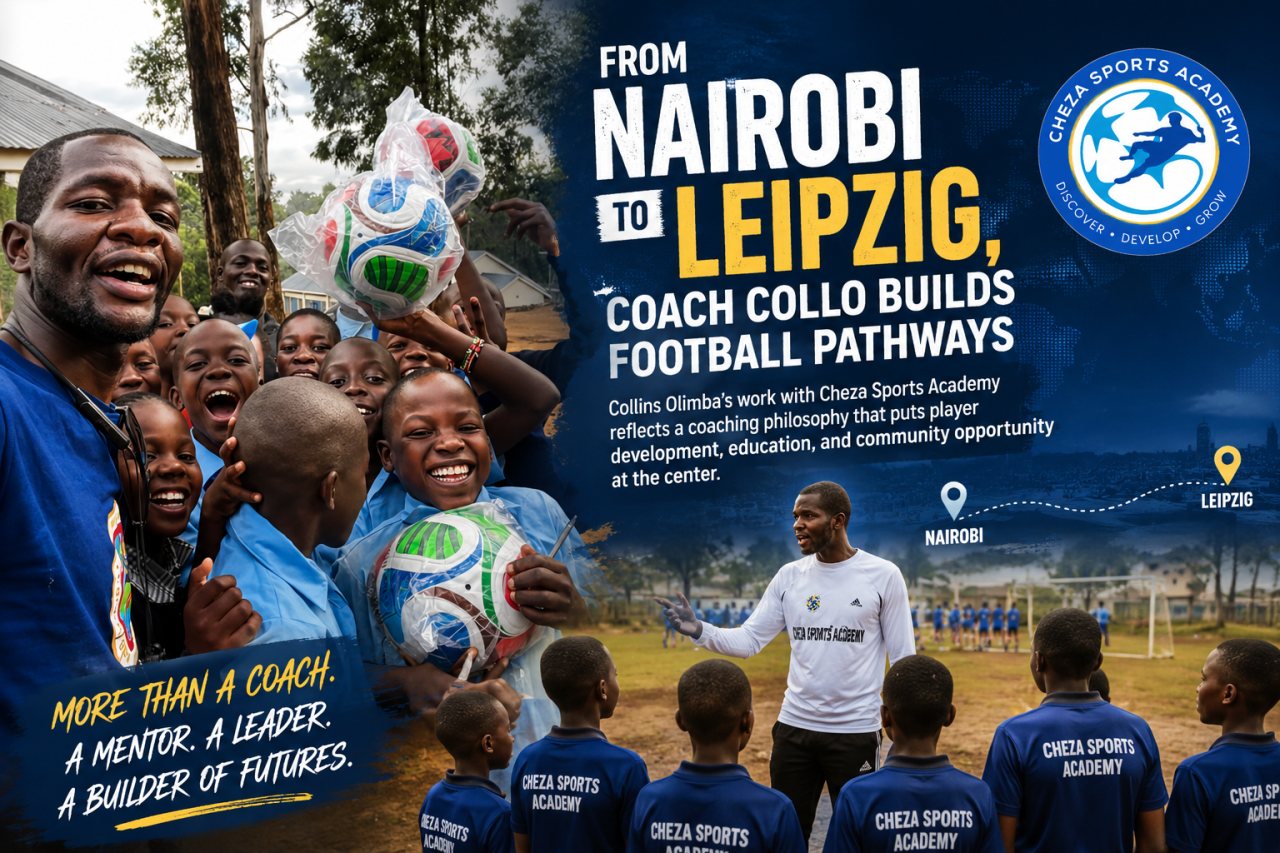
Collins Olimba’s work with Cheza Sports shows how coach education, long-term player development and community access can create opportunities that extend far beyond the pitch.
For Collins Olimba—better known as Coach Collo—football has never been only about finding the next standout player.
His work is built around a wider question: How can the game help a young person become more confident, disciplined and prepared for life?
Olimba has spent more than a decade pursuing that mission through Cheza Sports Academy and the broader Cheza Sports project in Nairobi. What began as a young coach’s effort to create opportunities for children has developed into a long-term commitment to player development, education, mentorship and community access.
His coaching journey has taken him from youth football in Mombasa and Nairobi to advanced study at Leipzig University in Germany. Yet the purpose behind the work has remained consistent: learn more, bring that knowledge home and create better pathways for the next generation.
Building opportunity through Cheza Sports
Olimba began coaching youth football with Cool Boys FC in Mikindani, Mombasa, in 2009. After moving to Nairobi, he recognized the number of talented young players in communities around South B and the nearby Mukuru area who needed more structured opportunities to train and develop.
Cheza Sports Academy grew from that need.
The academy says its programs are designed for players from early childhood through age 19, with an emphasis on developing technically capable, disciplined and well-rounded footballers. It also provides scholarship opportunities for talented players from less-resourced backgrounds, including young people from Mukuru.
That community element matters.
For many young players, development is not determined by talent alone. Access to coaching, transportation, equipment, safe facilities, academic support and consistent mentorship can all influence whether a player remains connected to the game.
A strong academy cannot remove every barrier, but it can become a reliable place where a young person is known, supported and challenged to improve.
Cheza’s technical policy reflects that wider responsibility. It emphasizes a player-centered approach, positive learning environments, individualized feedback and long-term progress rather than an exclusive focus on immediate results. The academy also identifies mental resilience, decision-making, sportsmanship and personal conduct as central parts of player development.
That philosophy gives Coach Collo’s work significance beyond the players who eventually reach the professional level.
Not every child who enters an academy will become a professional footballer. Every child, however, can leave the game with stronger habits, greater self-belief and a better understanding of teamwork, responsibility and perseverance.
Learning in Leipzig
Olimba’s development as a coach eventually took him to Germany, where he received a scholarship to study advanced football coaching at Leipzig University.
The university’s International Coaching Course is a postgraduate program created for coaches and physical-education professionals from developing countries. It combines theoretical study, practical learning and international exchange, allowing participants to study alongside coaches from different football cultures and development environments.
According to Cheza Sports, Olimba’s program covered technique, tactics, strength training, sports medicine, injury prevention and long-term player-development strategy. The experience also introduced him to more scientific approaches to coaching, including methods connecting movement, perception, physical preparation and decision-making.
One of the most valuable parts of the experience was the opportunity to observe RB Leipzig’s development environment.
Olimba attended sessions involving the club’s women’s team and academy, giving him a closer look at how an elite organization plans training, integrates physical preparation, evaluates player needs and builds development over time.
The value of that exposure was not simply in seeing professional facilities or collecting new drills.
It was in understanding the planning behind the work.
How is a session connected to a player’s long-term objective? How do coaches adjust training for age, position and physical condition? How are injury prevention and recovery incorporated? How do staff members communicate expectations without removing a player’s confidence or creativity?
Those details can be as important as any formation or tactical system.
Bringing the principles home
International coach education is most valuable when the lessons are adapted rather than copied.
The resources, infrastructure and competitive structures available to a Bundesliga academy are different from those available to a community-based organization in Nairobi. A model created for one environment cannot simply be transferred into another without considering the realities facing local players, families and coaches.
But strong principles can travel.
Better session planning can travel.
More thoughtful communication can travel.
Individual development goals, age-appropriate physical preparation and greater attention to injury prevention can travel.
So can the willingness to study, reflect and improve.
That is what makes Coach Collo’s experience relevant. His journey to Leipzig was not only about adding another qualification to his résumé. It created an opportunity to bring new knowledge into an existing grassroots ecosystem and determine how those ideas could serve young Kenyan players.
Cheza Sports said Olimba returned determined to introduce more evidence-based practices and contribute to a stronger culture of learning within his coaching community.
A pathway measured over years
The clearest evidence of a development program is not found in a single weekend result. It is found in what happens to players over several years.
Eric Naaman Balecho offers one example.
Balecho developed through Cheza Sports before progressing into higher levels of Kenyan football. In 2019, he was part of the South B United team that won the Nairobi regional stage of the Chapa Dimba tournament and advanced to the national finals.
His pathway continued.
Balecho later played an important role for Murang’a Seal, helping the club reach Kenya’s top division. In July 2024, Tusker FC announced his signing and identified him as a Cheza Sports Academy alumnus.
One player’s progress does not define an entire academy. But Balecho’s journey illustrates an important coaching principle: development requires patience.
A young player may show promise early, struggle during adolescence, change positions, lose confidence or need time to mature physically and emotionally. A coach who maintains the relationship, provides honest feedback and continues to recognize the player’s potential can have an influence that lasts well beyond a single season.
That is why youth coaching cannot be reduced to selecting the strongest team for the next match.
It requires recognizing that players develop on different timelines.
It also requires families, schools and coaches to work together. A young person is more likely to remain connected to the game when the adults around them support the process without making every performance feel like a final examination.
Developing the coaches who develop the players
Coach Collo’s path from Nairobi to Leipzig is also a reminder that coaches must continue developing themselves.
It is difficult to demand curiosity, discipline and improvement from young players when the adults leading them are unwilling to learn.
Coach education does not end with a license. It includes studying new methods, questioning old assumptions, listening to other coaches and understanding how social and economic realities affect the players entering a program.
The best coaches are not simply collectors of exercises. They are builders of environments.
They create places where players are allowed to make mistakes, where standards remain high without becoming destructive and where development is measured over months and years rather than one scoreboard.
Building more than players
Cheza Sports reports that three of its players received national-team call-ups in 2023. Those moments provide visible evidence that a pathway is working. But the academy’s deeper influence cannot be measured only through call-ups, contracts or trophies.
It can also be found in the young person who becomes more responsible.
The player who learns how to respond after being dropped.
The child who discovers confidence and belonging through a team.
The former player who returns to coach someone else.
Coach Collo’s story is ultimately about the possibilities created when education, football and community purpose work together.
From local pitches in Kenya to the training environments of Leipzig, his journey has reinforced a simple idea: football can open doors, but thoughtful coaching helps young people understand how to walk through them.
The next generation needs knowledgeable coaches. It also needs mentors who understand that the final score is only one part of the story.
For Collins Olimba, the larger objective remains clear—use football to help young people develop skills, character and pathways that can last far beyond the pitch.